
Top Houthi Messaging Themes: August 2026
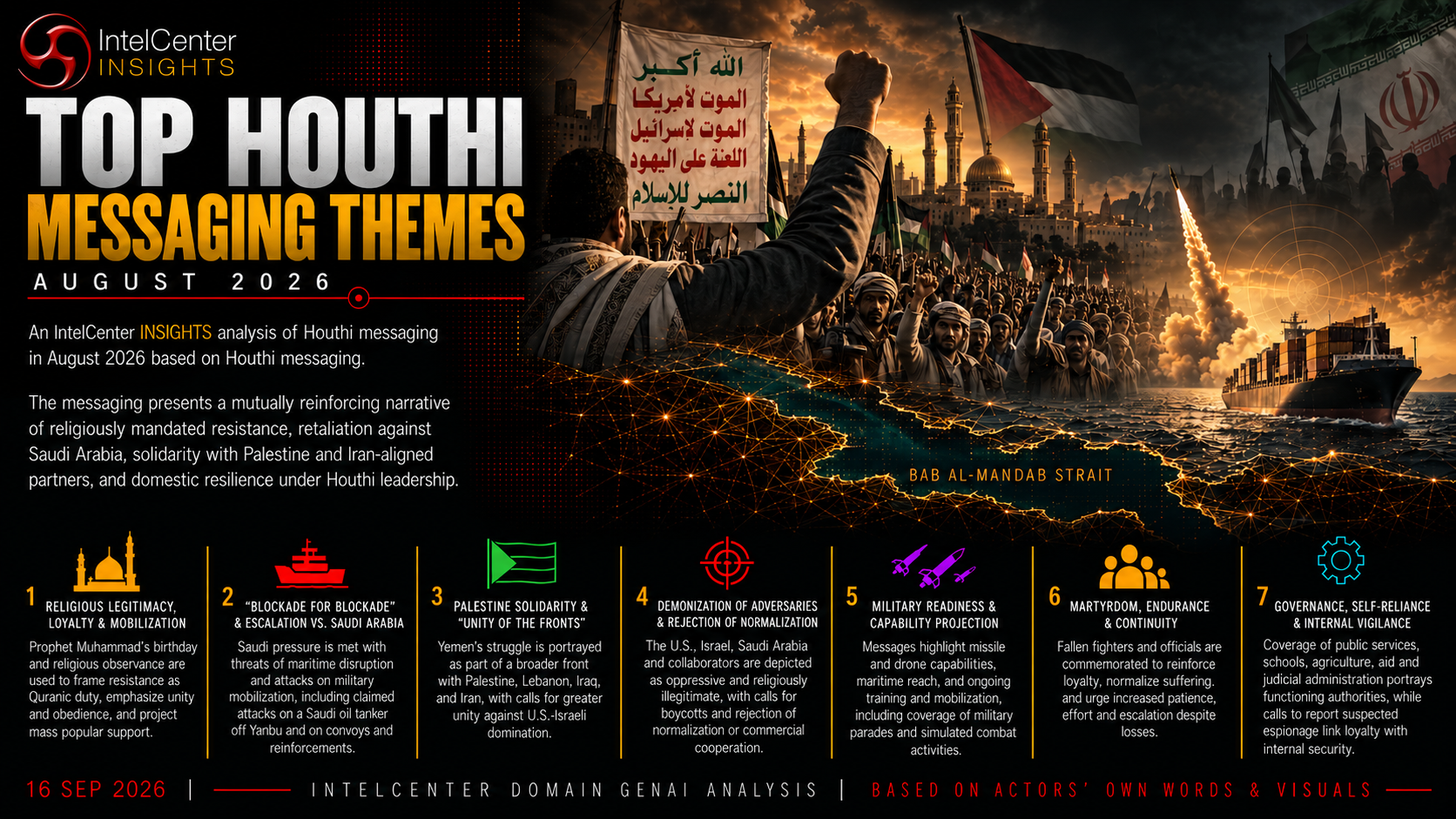
IntelCenter Domain GenAI Analysis
Houthi messaging in August 2026 presents a mutually reinforcing message of religiously mandated resistance, retaliation against Saudi Arabia, solidarity with Palestine and Iran-aligned partners and domestic resilience under Houthi leadership. The clearest operational signaling concerns Saudi-linked shipping and military mobilization; much of the remaining content emphasizes ideology, morale and legitimacy rather than specific attack plans. (ICD Video Component 471566, ICD Video Component 472197, ICD Video Component 474308)
The following themes are ranked qualitatively by prominence in the supplied holdings, not by a comprehensive count of August releases.
1. Religious legitimacy, loyalty and mass mobilization
Prophet Muhammad’s birthday commemorations provide a central framework for portraying Houthi leadership and resistance as expressions of Quranic duty. Addresses emphasize unity, obedience, independence, sacrifice and steadfastness, while coordinated rally coverage projects popular support across Houthi-controlled areas. Religious observance is thus presented as both spiritual commitment and political participation. (ICD Video Component 472317, ICD Video Component 471832, ICD Video Component 470911)
2. “Blockade for blockade” and escalation against Saudi Arabia
The most concrete coercive message is that Saudi pressure will be answered with maritime disruption and attacks on military mobilization. Abdul-Malik al-Houthi endorses reciprocal pressure and assigns Riyadh responsibility for the consequences. Military statements reinforce this with claimed attacks on a Saudi oil tanker off Yanbu and on convoys and reinforcements, alongside warnings of larger attacks if Saudi escalation continues. These are Houthi claims and threats, not independently established operational results. (ICD Video Component 473378, ICD Video Component 472197)
3. Palestine solidarity and “unity of the fronts”
Messaging portrays Yemen’s struggle as part of a broader confrontation involving Palestine, Lebanon, Iraq and Iran. Leadership addresses pledge support for Palestinian armed resistance and advocate greater unity among Iran-aligned fronts against perceived US-Israeli domination. This demonstrates a public commitment to regional alignment, but does not by itself establish operational coordination. (ICD Video Component 471564, ICD Video Component 473388)
4. Demonization of adversaries and rejection of normalization
The United States, Israel, Saudi Arabia and perceived collaborators are depicted as oppressive or religiously illegitimate adversaries. Some broadcasts extend this into explicit antisemitic and other sectarian hostility, portray normalization and commercial cooperation as betrayal and promote boycotts of US- and Israel-linked goods or businesses. The effect is to frame confrontation as a moral obligation extending beyond military activity. (ICD Video Component 472345, ICD Video Component 473995, ICD Video Component 471714)
5. Military readiness and capability projection
Communiqués, parades and edited montages advertise missile and drone capabilities, maritime reach and preparedness for prolonged confrontation. An August 24 commentary program highlights alleged anti-ship missiles and multiple drone families while warning of escalation after the religious celebrations. Mobilization coverage also depicts military-style training, including minors participating in simulated combat activities. These products show how the movement presents its readiness—not independently verified force strength or weapons performance. (ICD Video Component 471725, ICD Video Component 473283, ICD Video Component 474003)
6. Martyrdom, endurance and continuity after losses
Fallen fighters and officials are commemorated to reinforce loyalty and portray casualties as reasons for greater perseverance rather than retreat. Religious programming normalizes suffering and martyrdom as part of eventual victory; late-month messaging explicitly urges increased patience, effort and escalation despite sacrifices. (ICD Video Component 468489, ICD Video Component 472581, ICD Video Component 474308)
7. Governance, self-reliance and internal vigilance
News briefs pair confrontational regional coverage with schools, public services, judicial administration, agriculture, mediation and aid—presenting Houthi-aligned authorities as functioning institutions. Community deliveries to front-line forces link civilian economic activity to the military effort. Late-month broadcasts additionally encourage reporting suspected espionage, connecting movement loyalty with public surveillance and internal-security participation. (ICD Video Component 471475, ICD Video Component 474288, ICD Video Component 474336, ICD Video Component 473990)
Analytic distinction: The material supports an assessment of sustained mobilization and explicit willingness to escalate, particularly against Saudi-linked interests. It does not justify treating every hostile sermon, weapons montage or rally as evidence of an imminent operation. The more consequential warning content is concentrated in military communiqués and escalation-focused commentary. (ICD Video Component 472351, ICD Video Component 474003, ICD Video Component 472197, ICD Video Component 471725)
Scope: Sources with ICD primary dates of August 1–31, 2026 only. These holdings reflect entity-produced messaging and analysis of that media, rather than independent confirmation of the events portrayed.