
Deepfakes: Not as Simplistic or Binary as Many Think
AI developments are moving fast. So fast that something written even a few months ago may already be out of date. One area where I regularly see an outdated mindset is “deepfake detection.”
It often comes in the form of a simple request: Can you tell me which of these are deepfakes? Or a vendor pitch: We can detect deepfakes for you.
At IntelCenter, we have collected and processed more than 6 million images and videos from national security threat actors, with roughly 140,000 new images and videos flowing through our pipeline each week. From that perspective, I can tell you it has not been that simple for a long time, and it is not getting easier.
The first problem is that “deepfake” means different things to different people.
Some use it in the original sense: a manipulated photo or video where someone’s face was swapped, their mouth was altered, or an existing piece of media was deceptively edited.
Others use it more broadly to mean anything manipulated by AI.
Others use it as a catch-all for synthetic media.
Those are not the same thing.
Today, an image or video can be:
• A real capture enhanced with AI denoising, stabilization, upscaling, color correction, or frame interpolation
• A professionally edited news or documentary asset that used AI tools somewhere in the production workflow
• A real image with a small generated area, such as object removal or background extension
• A fully AI-generated scene
• A synthetic depiction of a real individual
• A face swap or manipulated person
• A misleading edit that changes the meaning of an event
• A harmless edit that changes nothing material at all
Those are very different categories.
That is why both “synthetic” and “deepfake” are becoming dangerously broad and potentially misleading labels.
A battlefield video prepared for broadcast may have passed through AI-assisted enhancement tools. That does not automatically make it deceptive.
A news photograph may have been resized, sharpened, cleaned up, compressed, or processed through modern production software. That does not automatically make it fake.
At the same time, an image or video can be entirely AI-generated and depict a real person, place, or event that never happened. That may not be a “deepfake” in the older sense of manipulating an existing image, but it can still be highly deceptive.
So the useful questions are no longer simply:
Is this AI-generated?
Is this a deepfake?
The better questions are:
• Was the media captured, generated, edited, or manipulated?
• Was the manipulation global or localized?
• Did it affect a face, voice, person, object, location, timestamp, document, weapon, explosion, casualty, or other material element?
• Does the edit change the evidentiary meaning of the image or video?
• Is this normal production enhancement, or is it deception?
• Is there provenance, chain of custody, or source context to support the claim being made?
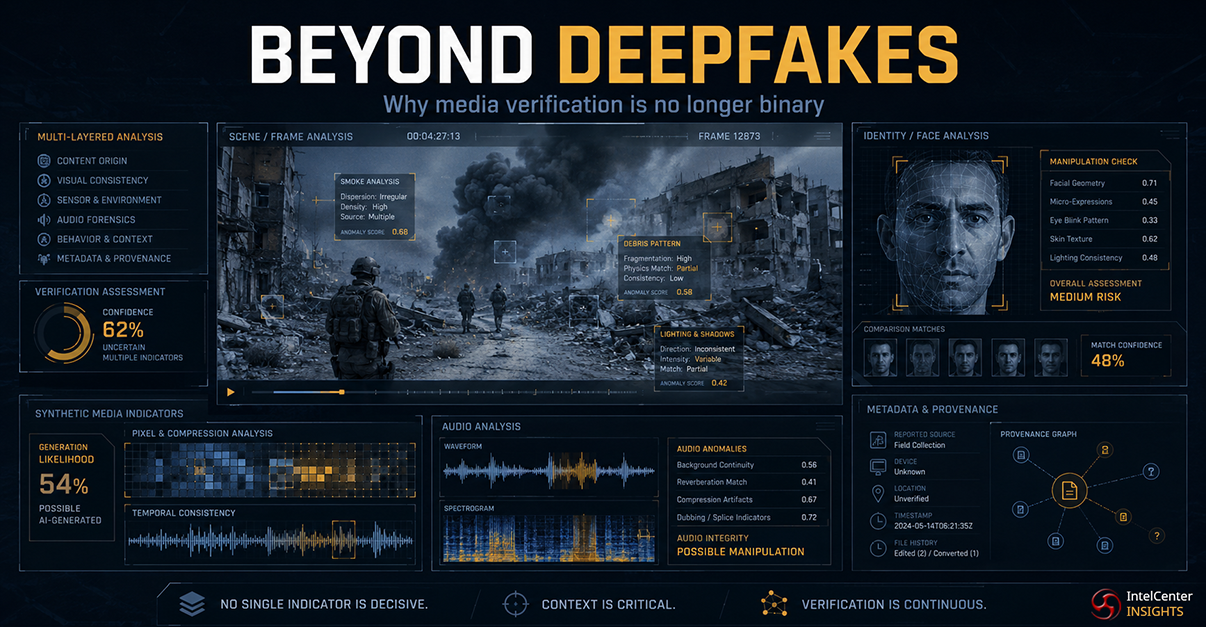
This is also why deepfake detection cannot be treated as a simple binary question with a probability score.
Some detection tools are primarily looking for face manipulation. Others look for fully AI-generated images. Others analyze video frames for synthetic patterns. Some return global scores. Some provide frame-level, face-level, or region-level indicators.
Those distinctions matter.
A “synthetic” signal may mean a fully generated image. It may also mean a real image that went through an AI upscaler.
A “deepfake” signal may mean identity manipulation. It may also miss synthetic environmental edits, such as generated smoke, debris, vehicles, or background changes, because many deepfake models are still face-centric.
For intelligence use cases, the goal should not be to label everything as “real” or “fake.” Ironically, that can itself be misleading.
The goal should be to understand what changed, where it changed, how confident we are, and whether that change affects the meaning of the content.
The future of media verification is not binary deepfake detection.
It is layered analysis: provenance, metadata, visual indicators, AI-generation detection, face and voice manipulation checks, scene-level review, source context, and human judgment.
AI has made deception easier.
But it has also made normal, legitimate media production more AI-assisted.
Our detection language and workflows need to catch up.
Ben Venzke
CEO